I will start off by wishing you well in these challenging times and by saying that the picture I paint in the following observations is not the picture I wish to be true; it is the picture that I believe to be true based on what I have learned and what the indicators that I use to objectively see things now suggest is true.
首先,我想祝各位在这荆棘密布的日子里一切安好。同时,也想说明一下:本文描绘的情景和所做的预测,并不是我希望它们成为现实;这只是我基于所学所见,使用客观指标分析现实得出的结论,而我认为它很真切。
As a global macro investor for over 50 years who has needed to study all things that affected markets over the last 500 years to know how to deal with what’s coming at me, it appears to me that most people tend to focus on and react to the attention-grabbing things that are going on at the time—like what is going on with Iran now—and miss the much bigger, more important, and longer-term-evolving things that are driving what is going on and what is likely to happen. For today, that is most importantly that the US-Israel-Iran war is just part of a world war that we are in and that isn’t going to end anytime soon.
我做了 50 多年的全球宏观投资,为了应对扑面而来的各种变化,我需要透彻地研究 500 年来影响市场的所有因素。以我的观察,大多数人往往只盯着当下最抓眼球的热点大事件(比如现在的美以伊战争),就做出反应和决策,却常常错过那些更大、更关键、而且在更长时间尺度上持续发酵的因素。可是,正是这些因素,决定了正在发生的事,以及接下来将会发生什么。就今天而言,最重要、最需要明白的是,我们已经身处一场世界大战之中,而且短期内看不到终局,美以伊战争只是冰山一角。
Certainly, what will happen with the Strait of Hormuz (most significantly, whether control of passage through it will be taken away from Iran and which countries are willing to spend how much blood and treasure to make that happen) will have many enormous repercussions all around the world. There are also the issues of whether Iran will still have a capacity to inflict harm on its neighbors with missiles and the threat of nuclear weapons, of how many troops the US is sending and what they will do, of the cost of gasoline, and of the upcoming US midterm elections.
当然,霍尔木兹海峡究竟鹿死谁手,会在全球范围内引发巨大的连锁反应(尤其是,伊朗会不会丧失对航道通行的控制权,以及哪些国家愿意为夺取控制权牺牲生命、付出代价)。除此之外,还有一系列同样棘手的问题:伊朗是否仍有能力使用导弹(以及核威胁)伤害周边地区;美国到底会派出多少兵力、执行什么任务;油价会飙到多少;以及美国即将到来的中期选举会如何改写局势。
All these near-term issues are important, but they lead people to miss the really big, even more important things. More specifically, because most people tend to have this short-term perspective, they now expect, and the markets are pricing in, that this war won’t last long and that when it ends we will get back to “normal.” Virtually nobody is talking about the fact that we are in the early stages of a world war that isn’t going to end anytime soon. Because I have this different perspective, I will now explain it.
这些短期的变量当然很重要,但也很容易把人的关注点带偏,让大家错过更大、更关键的变量。具体来说,因为大多数人习惯用短期视角看问题,所以现在普遍的预期是这场战争不会打太久,而且一旦结束,一切就会回归“正常”。市场也是根据这种预期交易的。几乎没人认为我们其实正处在一场世界大战的早期阶段,短期内根本看不到终局。既然我的角度不同,那么接下来我讲一讲我的理由。
Here are the really big things going on that I think we need to pay attention to:
我认为,眼下真正值得关注的是这些大事件:
While this sounds like hyperbole, it is indisputable that we are now in an interconnected world that has a number of shooting wars going on (e.g., the Russia-Ukraine-Europe-US war; the Israel-Gaza-Lebanon-Syria war; the Yemen-Sudan-Saudi Arabia-UAE war that also involves Kuwait, Egypt, Jordan, and other related countries; and the US-Israel-GCC-Iran war). Most of these wars involve major nuclear powers, and there are also significant non-shooting wars (i.e., trade, economic, capital, technology, and geopolitical influence wars) that most countries are in.
虽然听上去像夸大其词,但有一点无可争辩:现在的世界是高度互联的世界,同时进行着多场“真刀真枪”的战争(比如俄乌欧美之战;以色列—加沙—黎巴嫩—叙利亚之战;也门—苏丹—沙特—阿联酋之战,还牵连到科威特、埃及、约旦等更多国家;以及美以伊海合会之战)(译注)。大多数冲突都有重要核大国参与。与此同时,还有几场“非热战”在进行,同样不可忽视,也就是贸易战、经济战、资本战、科技战,以及地缘政治战,几乎每个国家都已卷入其中。
译注:海合会(GCC,海湾阿拉伯国家合作委员会)由沙特、阿联酋、科威特、卡塔尔、巴林、阿曼成立的地区组织,主要在安全防务、经济一体化与政策协调(尤其能源与地区外交)方面开展合作。
Together, these conflicts make up a very classic world war that is analogous to past “world wars.” For example, past “world wars” consisted of interrelated wars that were generally slipped into without any clear start dates or declarations of war. Those past wars combined into a classic world war dynamic that affected them all, as is happening with the current wars. I described that war dynamic in detail in Chapter 6, “The Big Cycle of External Order and Disorder,” of my book Principles for Dealing with the Changing World Order, which I published about five years ago, so it’s there if you want a more comprehensive description. That chapter covers the arc of what we are seeing happen and what is likely to happen.
这些冲突叠加在一起,构成了非常典型的“世界大战”,形态和历史上的两次“世界大战”高度相似。比如,前两次“世界大战”也是由一系列彼此牵连的战争拼接而成,找不到明确的开战日期,也没有正式的宣战,不知不觉就陷入了战争。多场战争相互牵动,形成一套典型的世界大战机制,又影响着每一场战争。这与当下正在发生的战争,是同样的逻辑。五年前,我出版了《原则:应对变化中的世界秩序》,其中第6章“外部秩序与混乱大周期” ,系统地拆解了“世界大战的机制”;如果你想完整地了解我们正在经历的历史规律,以及接下来会如何演进,可以直接去读那一章。
It is quite easy to see objectively how the sides are lining up via indicators such as their treaties and formal alliances, their votes at the United Nations, their leaders’ statements, and their actions. For example, one can see how China is aligned with Russia and Russia is aligned with Iran, North Korea, and Cuba, and how that group is largely opposed to the United States, Ukraine (which is aligned with most European countries), Israel, the GCC states, Japan, and Australia.
要客观地理清各方如何站队,其实不难:只需要看看它们签了什么条约、结成了哪些同盟,在联合国怎么投票,领导人怎么表态,以及现实里采取了什么行动。比如,我们可以清楚地看到:中国和俄罗斯走得很近,而俄罗斯又与伊朗、朝鲜、古巴彼此呼应;这一组力量,与美国、乌克兰(以及与乌结盟的大多数欧盟国家)、以色列、海合会国家、日本和澳大利亚对立。
These alliances matter a lot in imagining how things will go for the relevant players, so they need to be considered when observing what’s going on and what’s likely to happen. For example, we see this reflected in China’s and Russia’s actions at the UN on Iran needing to open the Strait of Hormuz. Similarly, as another example, while it’s said that China is particularly harmed by the closing of the Strait of Hormuz, that is wrong because China’s mutually supportive relationship with Iran will probably allow oil going to China to get through, and China’s relationship with Russia will ensure that China will get oil from Russia. China also has a lot of other energy (coal and solar) and a huge inventory of oil (about 90-120 days’ usage). Also noteworthy is that China consumes 80-90% of Iran’s oil output, which adds to the power of its relationship with Iran. All things considered, it appears that China and Russia are the relative economic and geopolitical winners from this war. As for the oil/energy economics, the United States is relatively advantaged, as it is in the enviable position of being an energy exporter.
对于各方接下来的走向、会走到哪一步,联盟关系的影响极大,所以在判断现状以及预判后续发展时,必须把它们纳入考量。比如,在“要求伊朗开放霍尔木兹海峡”的联合国决议投票中,中俄的投票显示出两国具有共同立场,是中俄友好关系的表现(译注)。有一个流行的说法,认为“中国会因霍尔木兹海峡关闭而遭受严重伤害”,但这其实是错的。因为中国与伊朗之间的关系,很可能会让输往中国的石油得以继续通过;同时,中国与俄罗斯的关系,也能确保中国能从俄罗斯获得石油供应。更何况,中国还有大量其他能源来源(比如煤炭与太阳能),并且拥有规模巨大的战略石油储备(大约可支撑 90–120 天的用量)。中国消耗了伊朗石油产出的 80–90%,这也进一步增强了中伊关系。综合来看,我认为,在这场战争中,中国和俄罗斯都是经济与地缘政治上的赢家。至于油气与能源的经济收益,美国反而相对占优,因为美国是能源出口国。
译注:2026年4月,巴林牵头、美国和部分海湾阿拉伯国家推动安理会决议草案表决,把伊朗在霍尔木兹海峡的做法定性为“对国际和平与安全的威胁”,并提出授权有关国家采取“防御性行动”,包括为商船护航乃至扩大在波斯湾的军事存在,实质是在向伊朗军事施压,并为可能的武装行动铺路。中俄作为常任理事国投了反对票。随后,中俄提出替代性决议草案,指出霍尔木兹海峡通航受阻的根本原因是美国和以色列对伊朗发动的非法军事行动,如果通过对伊朗强硬施压的草案,将向外界发出非常错误的信号,以后任何国家都可以借口“确保航行自由”在别国周边水域动用武力、扩大军事存在;一方面呼吁美国和以色列立即停止对伊朗的非法战争行为,另一方面也呼吁伊朗停止攻击海湾国家相关设施,尽快恢复霍尔木兹海峡的正常通航。
There are lots of ways of measuring these alliances, including UN voting records, economic ties, and major treaties. They all line up as I described. (If you’re interested in reviewing the major treaties, which are broadly indicative of the relationships, you can find them in Appendix 1. Likewise, if you’re interested in seeing the major existing and potential wars and what my indicators say about the odds of them happening and/or escalating during the next five years, you can find them in Appendix 2.)
辨别联盟关系的方法有很多,比如联合国投票、经贸往来、以及各类重大条约;现在呈现出来的阵营格局符合我上文的阐述。(如果你想了解重要盟约,可以看附录 1,它们大体能反映各方关系的亲疏;同样,如果你想了解已经发生和可能爆发的战争和冲突,以及我的指标对未来五年爆发战争和升级冲突的概率预测,可以参考附录 2。)
For example, both an examination of several analogous cases in history and logic make it obvious that how the United States (the dominant power of the post-1945 world order) performs in the war with Iran (a middle power), how much money and military equipment it expends and depletes itself of, and how well it defends (or doesn’t defend) its allies will be watched by other nations and will enormously influence how the world order changes. Most importantly, we know that what happens in the US-Israel-(and now)-GCC-countries war with Iran will have huge implications for what other countries (most importantly, those in Asia and Europe) will do, which will have big implications for how the world order will change.
比如,眼下,二战之后世界秩序的霸主美国,对一个区区中等国家伊朗发动战争,别的国家必然会密切关注美国在战场上的表现,看它花多少钱、消耗多少军备、把自己拖到什么程度,以及美国到底能不能保护自己的盟友。只要回看历史上的相似事件,再结合基本逻辑推演,就知道这些因素会深刻影响未来世界秩序会如何重塑。最关键的是,美以(还要加上)海合会国家与伊朗的这场战争走向,会直接改变其他国家的判断与行动,尤其是亚洲与欧洲的国家;而它们的选择,又会反过来进一步改写世界秩序的演变路径。
These changes will come in ways that have repeatedly happened before. For example, from studying history, it’s easy to identify overextended empires, develop indicators for how overextended they are, and see how they have suffered from being overextended. In looking at what is happening now, it is natural to examine what is happening with the US, which now has 750-800 military bases in 70-80 countries (by the way, China only has 1) and has commitments that create expensive vulnerabilities all over the world. It is also obvious that overextended powers cannot successfully fight wars on two or more fronts, which would lead to doubts about United States’s ability to fight a war on another front (e.g., in Asia and/or in Europe). So this naturally leads me to think about what the current war with Iran means for Asian and European dynamics as well as Middle Eastern dynamics. For example, it would not be surprising to see some problems develop in Asia that would test and reveal the United States’ willingness to rise to the challenge. This would be difficult for it to do because of its extensive preoccupying commitment in the Middle East and the lack of American public support for the Iran war going into the midterm elections, which makes fighting a war on another front implausible.
历史上,曾经反复上演过这样的大变局。比如,回看历史,很容易判断哪些帝国“摊子铺得太大”,也可以用指标计算过度扩张的程度,以及为此付出了什么代价。说回当下,这个帝国自然就是美国了。美国在七八十个国家拥有 750–800 个军事基地(相较之下,中国只有 1 个海外军事基地)(译注),为此美国要在世界各地维护安全,不仅代价高昂,还容易顾此失彼、左支右绌。还有一个规律显而易见:过度扩张和透支的霸权,在双线作战或者多线作战中不可能取得胜利。这让人不由得想,美国还有没有能力再开一个新战场,比如在亚洲,或者在欧洲。我也在想:这场对伊战争,对亚洲与欧洲的博弈格局意味着什么,对中东格局又意味着什么。举个例子,如果亚洲接下来发生新的摩擦,逼迫美国抉择能不能和要不要以身入局,也是意料之内。但对美国来说,以身入局、插足亚洲绝不轻松,因为它已经陷入中东的泥沼,难以脱身;再加上中期选举临近,美国国内对伊战争都缺少公众支持,使得美国几乎不可能再开辟新战场。
译注:中国唯一一个海外军事基地,是位于东非国家吉布提的“中国人民解放军驻吉布提保障基地”,以后勤与保障为主,而不是传统意义上的对外作战基地。核心功能包括:为亚丁湾、索马里海域的护航编队提供靠岸补给、休整和维修支持;为中国在非洲地区的维和部队、军事人员提供后勤保障;支持参与人道主义救援、灾害救助、海上搜救等行动;作为撤侨、护侨、紧急救援行动的前沿支点。
This dynamic might lead one to expect that other countries watching the dynamic with the US and Iran might change their calculations and behaviors in ways that will reshape the world order. For example, it is logical that leaders of countries with US military bases in them who expect the US to defend them could learn lessons and change behaviors based on how things go for those Middle Eastern countries with US military bases that expect the US to defend them. Similarly, one might conclude that any country that is close to any strait that could be strategically important and/or that has American bases on its territory in a part of the world where there could be a big conflict (such as in Asia, where there could be a conflict between the US and China) will watch and take lessons from what is happening in the Iran war. I assure you that that type of thinking is now happening among world leaders and that what is now happening has happened many times before in similar parts of the Big Cycle. These calculations by world leaders are part of a classic sequence of steps leading to major wars that has repeatedly taken place and is now happening. Looking at today’s events and knowing this classic international world order/conflict cycle, it is apparent to me that we have progressed to Step 9. Does it look that way to you? Here is the classic sequence of steps:
旁观国家的态度是“我倒要看看美伊战争会打成什么样”,战局会让他们重新盘算,进而调整策略,并进一步改写世界秩序的走向。比如,很明显,那些境内驻扎美军基地、曾经指望美国出兵保护的国家,看着中东那些同样“有美军基地、指望美国兜底”的国家,就会吸取经验教训,然后未雨绸缪。同理,具有重大战略价值海峡附近的国家,或者潜在冲突地区内驻扎美军基地的国家(比如可能爆发中美冲突的亚洲,就有驻扎美军基地的国家),它们也会盯着美伊战争的进展,从中总结教训。我可以肯定地说:此时此刻,世界各国领导人都在做这样的思考。而且,历史上的“大周期”里,类似的事情也曾反复上演。换句话说,这些世界领导人的思考和权衡,本身就是“大战前夕”的经典环节之一,大战前的一系列事件,遵循一套经典的演进步骤,历史上反复发生,如今也正在发生。放在今天,这套国际秩序与冲突的经典周期律,我认为已经推进到了第 9 步。这套经典的演进步骤如下,不知道你是否同意:
1.The economic and military strengths of the dominant world power(s) fall relative to those of the rising world power(s), leading them to become roughly comparable powers and to begin challenging each other in economic and military conflicts over their disagreements.
1.既有的世界霸权在经济与军事实力上相对走弱,而崛起中的强国在相对走强。此消彼长之下,双方实力逐渐拉近,开始围绕分歧在经济与军事层面相互试探、彼此对撞。
2.Big increases in economic wars take the form of economic sanctions and trade blockages.
2.经济战显著升级,往往表现为经济制裁与贸易封锁。
3.Economic, military, and ideological alliances form.
3.经济、军事与意识形态层面的联盟开始成形。
4.Proxy wars increase.
4.代理人战争越来越多。
5.Financial stress, deficits, and debts increase, especially for the leading powers that are most overextended financially.
5.金融压力、财政赤字与债务负担不断加剧,尤其是财政上透支最严重的头部强国。
6.Critical industries and supply chains are increasingly controlled by governments.
6.各国政府直接掌控的关键产业与供应链越来越多。
7.Trade chokepoints become weaponized.
7.关键的贸易咽喉要道被武器化,成了互相卡脖子的筹码。
8.Powerful new technologies for war are built.
8.可用于战争的强大新技术出现。
9.Multi-theater conflicts increasingly happen simultaneously.
9.多战区同时爆发的冲突越来越常见。
10.Within countries, loyal support for the country’s leadership is demanded and opposition to the war and other policies is squashed, because as Lincoln quoted from the Bible, “A house divided against itself cannot stand,” especially when it is at war.
10.各国国内,领导层越来越强调“忠诚”;反战以及其他政策的反对意见会受到打压。正如林肯总统引用《圣经》所说:“内部四分五裂的家族,必定无法立足”;尤其在战争时期,更不容许内部撕裂。
11.Direct military combat between major powers occurs.
11.主要大国之间爆发直接军事冲突。
12.There are big increases in taxes, debt issuance, money creation, FX controls, capital controls, and financial repression to finance the wars. In some cases, markets are shut down. (Read Chapter 7 in Principles for Dealing with the Changing World Order for a more complete explanation of investing during war.)
12.为了支撑战争的耗费,税负会明显上升;政府会大规模发债、印钞;外汇管制与资本管制会加码;金融制裁也会增加。有时候,甚至会直接关停金融市场。(如果你想更完整地理解“战争时期该如何投资”,可以去读《原则:应对变化中的世界秩序》中的第 7 章。)
13.Eventually, one side beats the other and gains indisputable control of the new order, which is designed by the winning side.
13.最终,一方击败另一方,并以无可争辩的方式掌控新的秩序;而这套新秩序,将由胜利者设计。
I have many indicators suggesting that we are in the part of the Big Cycle when the monetary order, some domestic political orders, and the geopolitical world order are breaking down. These indicators suggest that we are in a transition stage from the pre-fighting stage to the fighting stage, which is roughly analogous to the 1913-14 and the 1938-39 periods. To be clear, there is nothing precise about these indicators, the picture they paint, or the exact timing.
我的很多指标都表明:大周期现在所处的阶段,是“货币秩序”、部分国家的“国内政治秩序”,以及“地缘政治的世界秩序”同步松动、开始崩解的阶段。这些指标还表明:我们正从“大战一触即发”的阶段,过渡到“大战爆发”的阶段,大致对应历史上 1913–14 年、以及 1938–39 年那段时期。我要强调,这些指标并非精密指标,它们描绘的图景不完全精确,更无法给出准确的时间点。
The indicators are just broadly indicative. For example, history has taught us that wars generally don’t have definitive start dates (with big military events followed by clear declarations of war, like the assassination of Archduke Ferdinand, the German invasion of Poland, and the bombing of Pearl Harbor, being the exception), and economic, financial, and military conflicts typically arose before there were clearly declared wars. Major wars were also typically preceded by developments and indicators like 1) military stockpiles and monies being drawn down; 2) budgets, debts, money printing, and capital controls being built up; 3) rival countries observing the countries fighting and learning what their strengths and weaknesses are; and 4) the overextended leading world power facing the challenge of trying to fight wars on different fronts that are very far apart. These factors all matter, and my measures of them indicate that we should be concerned.
这些指标只具有“粗略参考”价值。比如,历史告诉我们:战争往往没有板上钉钉的“开战日”,而且在明确宣战之前,经济冲突、金融对抗和军事摩擦早就已经先一步发生了。有标志性的军事事件和明确宣战的只是少数,例如斐迪南大公遇刺、德国入侵波兰、以及轰炸珍珠港。通常,爆发大战之前,会出现一些“迹象”和“前奏”:1)军备库存与可支配资金持续消耗;2)预算赤字、债务、印钞发钞与资本管制逐步推高;3)对立阵营一边观战一边复盘,从交战各方身上摸清强弱与短板;4)过度扩张的既有霸权,面对彼此相隔遥远的多条战线,开始倍感压力,显得力不从心。这些因素都很重要,而我的指标显示:我们现在需要提高警惕了。
The classic dynamic at this stage in the cycle is for conflicts to intensify rather than subside, so what happens next will be influenced by how the US-Iran war goes. For example, there is already less confidence among some countries that the US will defend them, which, when combined with the recognition that nuclear weapons are a great defensive as well as offensive power, is leading to more talk among countries’ senior policy makers about obtaining nuclear weapons and building up their stockpiles of them and other weapons, particularly missiles and missile defense systems.
在大周期的这个阶段,冲突往往会升级,而不会自行降温。所以,接下来会怎么走,很大程度上取决于美伊战争打成什么样。比如,已经有一些国家的信心在动摇,不再笃信“美国一定会出手保护他们”;再加上各国越来越清醒地意识到,核武器既是进攻力量,也是最强的防御底牌。这两点相叠加,正在让越来越多国家的高层决策者认真考虑拥核,以及增加核武储备,增加其他武器库存(尤其是导弹、反导系统)。
To reiterate, I’m not saying that things will definitely progress further along this cycle to an all-out world war. I don’t know what’s going to happen, and I still hope for a peaceful world built on win-win relationships rather than damaged by lose-lose ones. I try in my own small ways to help that. For example, I have had wonderful, simultaneous 42-year relationships with both Chinese and US senior policy makers (as well as people outside of leadership), so in the past and especially during this contentious time, I have tried to support a win-win relationship in ways that are appreciated by leaders from both sides. I do this because I have affections for those on both sides and because win-win relationships are much better than lose-lose ones, even though this is getting tougher for me to do because some people think that “the friend of my enemy is my enemy.”
再强调一遍:我不是说这个周期一定会一路发展下去,最终走向全面世界大战爆发。接下来会发生什么,我也不知道。我仍然希望这个世界能建立在双赢关系之上,而不是被两败俱伤的对抗撕裂。我也一直在用自己力所能及的方式,去推动这样的双赢。比如,我与中美的高层政策者(也包括非领导层的人士)同时保持着长达 42 年的良好关系。不管是过去,还是在眼下火药味十足的时刻,我都一直努力建设更好的双赢关系,也得到了两边领导人的认可。我之所以这么做,一是因为我对两国人民都怀有感情;也因为双赢关系远胜于两败俱伤。只是现在这件事越来越难了,因为有些人坚信:“敌人的朋友,就是敌人”。
At this stage of the Big Cycle, just before major wars, circumstances like the inability to resolve irreconcilable disputes with compromises typically drive one stage in the cycle unavoidably to the next until there is a violent resolution, so it’s important to understand the typical Big Cycle and watch what is happening. By giving you my template to compare with actual events as they transpire, my hope is that I can help you see what I am seeing and then decide what you want to do about it.
在大周期的这个阶段,也就是全面大战爆发前夕,局势往往会被一种“无法妥协的硬冲突”推着走:彼此谈不拢、又不愿用妥协化解矛盾时,就必然滑向大周期的下一个阶段,直到最终以暴力冲突步入结局。所以,我们要真正理解这套“大周期”的演进规律,就得持续关注正在发生的事。我与你分享大周期的框架,是想让你用它去对照现实事件在不同节点上的体现,帮助你看见我所看见的东西,然后决定自己要怎么应对。
Consistent with that, I believe that it is important to see that: the world order has changed from a multilateral rules-based world order led by the dominant US power and its allies (e.g., the G7) to a might-is-right world order with no single dominant power enforcing order, which means that we can expect more fighting. A student of history would recognize that the world order is now more like that which existed through most of history prior to 1945 than the post-1945 period we are used to and would understand what the most important implications of this are.
顺着这个逻辑,我认为有一点必须认清:世界秩序已经发生了质变——原本“由美国及其盟友(比如G7集团)主导、以多边主义规则为基础”的世界秩序,已经滑向“强者说了算、没有单一霸权能维持秩序”的新格局;也因此,我们可以预期,接下来只会更频繁地动武、爆发更多冲突。熟悉历史的人会觉得:今天的世界秩序,很像 1945 年之前的局面,而不是我们过去几十年习惯的“战后秩序”;我们应该追问:最重要的启示是什么。
That certainly is a factor in the US-Iran war, with the president assuring the American public that the war will be over in a couple of weeks, gas prices will then decline, and we will go back to our normal prosperous times. There are many good indicators that point to whether a country has the capacity to endure the pain for an extended period of time, such as popularity polls (especially in democracies) and/or the power of government leaders to remain in control (especially in autocracies, where popular opinion doesn’t matter as much). In fighting wars, winning doesn’t occur until surrender. That is because it is impossible to eliminate all enemies. When China entered the Korean War against the United States at a time when China had very little power and the United States was a nuclear power, Mao supposedly said, “They can’t kill us all,” meaning that the enemy can’t win if there are people who keep fighting. The lessons of Vietnam, Iraq, and Afghanistan are clear. Winning happens when the winning country can get out with the losing country no longer remaining a threat. While the United States appears to be the most powerful country in the world, it is also the most overextended major power and the weakest at withstanding pain over a long period of time.
这也是美伊战争里的关键变量:一边是美国总统向美国人民打包票,说“再过两周就能结束战争”;一边又承诺油价会回落,日子很快就能回到过去那种“繁荣的正常”轨道上。判断一个国家能不能长期忍辱负重、咬紧牙关,有很多好用的指标,比如民意支持度(尤其在民主国家),以及政府领导层维持统治的能力(尤其在威权体制里,民意的约束没那么强)。战争中,不是“杀光敌人”就能赢得胜利,而是要对方“认输”,因为敌人永远不可能被彻底消灭。朝鲜战争时期,中国百废待兴,又面对拥有核武器的强大美国,但据说毛主席曾说:“中国人民是打不垮的。”意思是,只要还有中国人继续战斗,敌人就不可能胜利。美国在越南、伊拉克、阿富汗的教训也很清楚:美国所谓的“赢”,只是能够抽身离开,而输的一方不再构成威胁。所以,虽然美国看起来仍是世界上最强大的国家,但它也是“摊子铺得最大、透支最严重”,最无法忍受长期痛苦、缺少韧性的霸权。
By “classic Big Cycle way,” I mean that events are primarily driven by the five big forces:
所谓“大周期的经典剧本”,是指现实中的大事件受五种“力量”推进:
1.Money, debt, and economics in big cycles of monetary order and disorder;
1.经济力量:经济大周期里,货币、债务与经济因素反复摆动;
2.Political and social orders breaking down because of big wealth and value differences;
2.内部环境力量:因为巨大的财富差距与价值观撕裂,国内政治与社会秩序崩解;
3.Regional and world orders breaking down because of big wealth and value differences;
3.外部环境力量:同样因为巨大的财富差距与价值观撕裂,地区秩序与世界秩序瓦解;
4.Great advances in technology that are being used for both peaceful and war purposes, and the financial bubbles related to them that typically turn into busts; and
4.科技力量:科技出现巨大跃迁,既有助于和平发展,也能被用于战争;同时围绕这些技术形成金融泡沫,从“狂热”走向“崩盘”;
5.Acts of nature such as droughts, floods, and pandemics.
5.自然力量:自然灾害,比如干旱、洪水和疫情。
While I won’t bore you with a more in-depth description of how the Big Cycle works and the five big forces driving it and the 18 determinants underlying them, I will again suggest that you understand it and direct you to my book or YouTube video, both named Principles for Dealing with the Changing World Order.
至于“大周期”怎么运作、背后的五股力量怎么推动它,以及其下更详细的 18 个决定因素,我就不在这里展开讲了,免得啰嗦。但我还是想再强调一次:这套框架值得你花时间了解。我鼓励你去读我的书,或者看同名视频,《原则:应对变化中的世界秩序》。
Many of the indicators I use to track unfolding events are explained in Principles for Dealing with the Changing World Order. I especially recommend Chapter 6, “The Big Cycle of External Order and Disorder,” and, if you are interested in the unimaginable-in-peacetime investment-related developments that typically happen during wars, I recommend Chapter 7, “Investing in Light of the Big Cycle.” I recently shared these chapters online and you can find them here and here.
我用来追踪局势演变的许多指标,都在《原则:应对变化中的世界秩序》里解释过。我尤其推荐第 6 章“外部秩序与混乱大周期”。如果你关心“和平年代难以想象、但战争时期却常见”的投资策略,我也建议你读一读第 7 章“在大周期视角下投资”。我最近把这两章内容放到了网上,你可以点击这里和这里的链接阅读。
译注:本文译者已将第6章翻译完毕,点击上文链接将跳转到译文。第7章还没有翻译,所以这里的链接是英文原文页面。如果你希望我将第7章翻译成中文,请在本文点赞或留言,我会尽快翻译。
That’s my up-to-date big picture perspective. Because I use it to influence how I invest and what I should do in other aspects of my life, I will turn to those things next. As referenced above, what follows are two appendices sharing some information about the relevant alliances between countries and brief summaries of existing and potential significant wars.
到这里,就是我对当前局势的“全面判断”。由于我用这套判断做投资决策,以及生活中其他重要决定,所以下面我会顺着这个话题,继续谈谈更具体的事。上文提到,接下来是两个附录:一个汇总相关国家之间的重要盟约;另一个则对已经发生、以及可能发生的重大战争做一个简要梳理。
Below are what appear to be the most important treaties, the strength of the commitments implied by each of them on a 1 to 5 scale, and a brief description of each treaty. By and large, other measures of allegiances (such as leaders’ statements and actual actions taken) are aligned with these treaties. However, it is now clear that all these treaties, especially those with the US, are subject to change and that actual actions will speak louder than agreements.
下面列出的,是我认为最重要的几份盟约:我给每个盟友关系的紧密程度都打了分,1分最疏松,5分最紧密,并配了简要说明。总体而言,其他衡量“站队与亲疏”的指标(例如领导人表态、以及现实中采取的实际行动)与这些条约呈现出的阵营格局基本一致。但现在来看,可以明确的是:所有盟约,尤其是与美国的盟约,随时都可能生变;真正算数的,从来都是行动,而不是纸面上的约定。
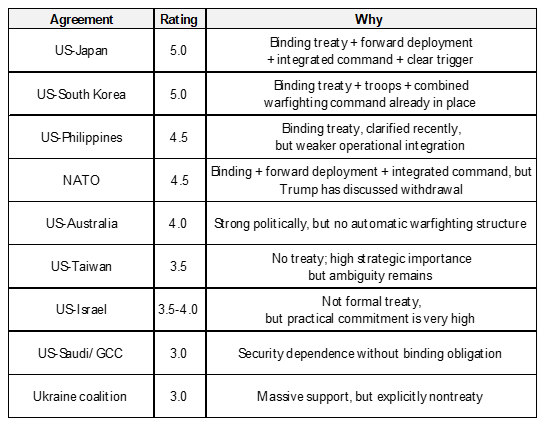
盟约 | 评分 | 说明 |
美日 | 5.0 | 具有约束力的条约 + 前沿部署 + 一体化指挥体系 + 明确的触发机制 |
美韩 | 5.0 | 具有约束力的条约 + 军队驻扎 + 已建立联合作战指挥体系 |
美菲 | 4.5 | 具有约束力的条约,近期得到明确,但作战整合程度较弱 |
北约 | 4.5 | 具有约束力 + 前沿部署 + 一体化指挥体系,但特朗普曾讨论过撤出 |
美澳 | 4.0 | 政治上联系非常紧密,但没有自动触发的联合作战架构 |
美国与中国台湾 | 3.5 | 无正式条约;战略重要性高,但仍然保持战略模糊 |
美以 | 3.5–4.0 | 无正式条约,但实际联盟非常紧密 |
美沙特/海合会 | 3.0 | 存在安全依赖,但缺乏具有约束力的义务 |
乌克兰联盟 | 3.0 | 提供巨大支持,但明确为非条约性质 |
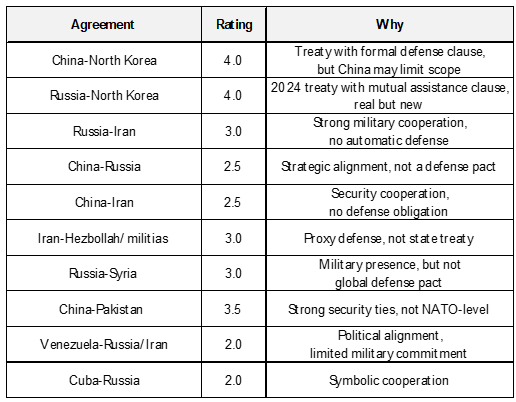
盟约 | 评分 | 说明 |
中朝 | 4.0 | 有正式防御条款的条约,但中国可能会限定适用范围 |
俄朝 | 4.0 | 2024 年签署的相互援助条约,尚属新近达成 |
俄伊 | 3.0 | 紧密的军事合作,但没有自动触发的共同防御义务 |
中俄 | 2.5 | 战略一致,而非共同防御条约 |
中伊 | 2.5 | 安全部门合作,但没有共同防御义务 |
伊朗–真主党/民兵组织 | 3.0 | 代理防御关系,而非国家层面的条约 |
俄叙 | 3.0 | 有军事存在,但不是全面的共同防御条约 |
中巴 | 3.5 | 安全关系紧密,但未达到北约级别 |
委内瑞拉–俄罗斯/伊朗 | 2.0 | 政治立场一致,但军事承诺有限 |
古巴–俄罗斯 | 2.0 | 主要是象征性的合作 |
What follows are what I consider the major existing and potential wars, a brief description of their situations as I see them, and my assessed probability of a military war breaking out or escalating within the next five years.
我认为,下面这些战争,是最重要的几场“已经发生”和“可能爆发”的战争。我会用我自己的视角,简要描述它们的现状,并给出我判断未来五年内爆发或升级为军事冲突的概率。
This is now an all-out war that appears to be intensifying, with all sides depleting their resources. Things to look out for include a) which side ends up controlling the Strait of Hormuz, Iran’s nuclear materials, and the Iranian missiles; b) the relative willingness of each country to expend blood and treasure to win the war; c) the satisfaction of the countries involved with their alliances; d) the entrance into the war or the selling of weapons in support of Iran by one of Iran’s allied powers (like North Korea) or the outbreak of a conflict in Asia, which would require the US to have to choose between meeting its commitments to act and failing to act; and d) whether peace and safety are restored to the Gulf region.
这场战争已经全面开打,而且看起来还在升级,各方都在持续消耗资源。接下来要重点关注以下变量:a)谁能控制霍尔木兹海峡和伊朗的核原料,以及伊朗的导弹力量;b)各方为了赢得战争,愿意付出多少生命与财力;c)参战国家对各自联盟关系的满意程度;d)伊朗的盟国(比如朝鲜)是否会下场参战,或者以“向伊朗提供武器”的方式实质介入;以及亚洲是否会爆发新的冲突,从而迫使美国在“履行防御承诺介入亚洲”与“不介入”之间做出艰难取舍;同时还要看,海湾地区的和平与安全是否能真正恢复。
This active military war involving all the great military powers (except China) is a very risky situation, though it has not escalated beyond Ukraine for three years, which is good because a broader war has thus far been avoided. Currently, Russia is fighting Ukraine, NATO is supplying Ukraine with weapons at significant financial cost, and military spending in Europe and preparation for war with Russia are increasing. NATO troops not fighting directly and mutual fear of nuclear war are currently containing the war. The things to watch out for to signal a worsening are a Russian strike on a NATO territory or an attack on supply lines, NATO intervention in the military war, and/or an accidental clash between Russia and a NATO nation. I think that the odds are against these things happening and the war expanding beyond Ukraine, so I’d say that there is about a 30-40% chance of that happening over the next five years.
这场仍在进行的战争,几乎把(除中国外)所有主要军事强国都卷了进来,风险极高。好消息是,三年来它都没有溢出乌克兰边界,意味着更大范围的战争暂时避免。当前的形势是:俄罗斯与乌克兰作战;北约付出巨大财政成本向乌克兰提供武器;欧洲的军费开支上升,加强“与俄罗斯开战”的准备。北约部队没有直接参战,双方对核战争都心怀恐惧,这两个因素压制局势没有升级。判断局势恶化的关键信号包括:俄罗斯打击北约领土或攻击补给线;北约直接介入军事行动;或者俄罗斯与某个北约国家发生意外冲突。我认为这些情况发生、并导致战争扩展到乌克兰之外的概率不高,因此我估计未来五年,这些风险发生的概率大约是 30–40%。
The US and China are in ideological, technological, trade, economic, and geopolitical influence wars, but not yet a military war. But the Taiwan issue, which is a nonnegotiable sovereignty issue to Chinese leaders and the Chinese people, remains a flash point. All parties are openly preparing for a military war, spending a lot and developing a lot of military hardware to fight such wars. China has produced thousands of hypersonic, cruise, and ballistic missiles capable of precision strikes, along with millions of drones. US bases, aircraft, naval vessels, and other infrastructure operating within the First Island Chain—which extends south from Japan through Taiwan, the northern Philippines, and Borneo—are highly vulnerable. Things to look out for are a big increase or decreases in US support for Taiwan’s independence; a blockade by China; a US-Chinese military clash (accidental or intentional) that costs lives; and a more direct action by China to take control, possibly motivated by a belief that the US is too weak militarily, financially, politically, and/or geopolitically to fight back. More likely, the attack(s) would be made too subtly to even notice. If you don’t know what I mean by that, I suggest that you read The Art of War. I estimate the probability of a US-Chinese military war over this at 30-40%, with the greatest-risk period in 2028.
中美之间,早已在意识形态、科技、贸易、经济、以及地缘政治影响力层面进入“战争状态”,但军事战争还没有真正开打。不过,台湾问题仍然是火药桶。对中国领导层与中国人民而言,台湾问题是不可谈判的主权问题。各方都在公开为军事冲突做准备,投入大量资源、研发大量装备。中国已生产成千上万的高超音速导弹、巡航导弹与弹道导弹,具备精确打击能力,同时还拥有数量庞大的无人机体系。美国在第一岛链内的基地、战机、军舰以及其他基础设施,暴露在火力之下,极易遭受打击。(译注)接下来要关注的变量包括:美国对“台湾独立”的支持是否大幅增加或减少;中国是否实施封锁;中美是否发生造成伤亡的军事冲突(不管是意外还是计划内);以及中国是否采取更直接的方式实控台湾岛,这尤其取决于中国是否认为美国在军事、财政、政治和地缘政治层面都“无力反击”。我认为更可能的情况是,双方会以非常隐蔽的方式相互攻击,外人甚至难以察觉。如果你不理解我说的“隐蔽”,我建议你读一读《孙子兵法》。我估计未来五年内,中美因台湾问题爆发军事冲突的概率在 30–40%,其中风险最高的时间窗口在 2028 年。
译注:第一岛链,简单说就是在中国东部沿海外面、沿西太平洋分布的一串岛屿带,从日本向南,经台湾岛、菲律宾北部到婆罗洲。第一岛链大致把西太平洋和中国近海(黄海、东海、南海)分隔开,是进出西太平洋的重要通道带。美国在冷战时期提出“岛链战略”,用来遏制苏联和中国等大陆共产主义力量向外扩张。第一岛链把内外海域分割,进出必须经过少数几条海峡和水道(如宫古海峡、巴士海峡等),因此,掌握岛链的一方可以监视、管控这些通道,对其他国家舰机出入西太平洋形成制约。
North Korea is a provocative nuclear power that has shown a willingness to fight for other countries that it is aligned with against the United States. It also has missiles that can carry nuclear warheads and reach the US mainland, but they are unreliable. Over the next five years, they will be improved considerably. North Korea has been particularly close to both China and Russia and could be an effective proxy of theirs. It is also particularly bold in developing and displaying its missile capabilities, but it would not sell these weapons to other countries. I would put the odds of some sort of military fight with North Korea over the next five years at 40-50%.
朝鲜是个极具挑衅性的拥核国家,而且已经表现出“替盟友打仗”、与美国对抗的意愿。朝鲜也拥有能够携带核弹头、理论上可以打到美国本土的导弹,只是目前可靠性不高。未来五年内,这些能力很可能会显著提升。朝鲜与中国、俄罗斯的关系都特别紧密,可能会成为它们有力的代理人。同时,朝鲜也在非常大胆地研发和展示导弹能力,但它不会把这些武器出口给其他国家。我估计未来五年内,围绕朝鲜爆发军事冲突的概率在 40–50%。
There is a NATO-like treaty between the US and the Philippines, and there have been Chinese coast guard confrontations that could involve US naval patrols. It wouldn’t take much—e.g., a ship collision, a Chinese attack on a Philippine vessel, a blockade, or a missile incident—for the US to be expected to step in to meet its treaty obligations, yet it is inconceivable that the American electorate would stand for that. This would put the US leadership in the position of having to make a very difficult and very telling choice. I’d put the odds of this conflict over the next five years to be about 30%.
美国与菲律宾之间存在某种“类北约”的盟约关系,而中国海警与菲方的对峙,可能会把美国海军巡逻也卷进来。在这里,不需要多大火星,局势就能引爆,可能只是船只碰撞、中国攻击菲律宾船只、中国实施封锁,或者导弹出事。一旦出事,就可能引发连锁反应,外界会期待美国出手介入,履行共同防御义务。但与此同时,几乎可以断定,美国选民不愿意美国介入这个冲突或者参战。这会把美国领导层推到极其艰难的境地,考验他的能力与意志。我估计未来五年内,这一冲突的概率大约是 30%。
Looking across all these potential conflicts, the odds of at least one of them happening over the next five years appears to me to be greater than 50%.
把这些潜在冲突放在一起看,我认为未来五年内发生,爆发其中之一的概率,高于 50%。
Loading...